Parking lots for businesses, HOAs and property managers
A parking lot is the first thing customers, tenants and residents see, and it is also a liability. Holes, broken edges and standing water lead to complaints, damaged vehicles and trip hazards. We provide parking lot paving in NJ for retail centers, office and medical buildings, warehouses, churches, apartment complexes, condominium associations and HOAs, and owners who manage their own buildings.
Our job is to give you a lot that drains, holds up to the traffic it carries, and was paved with as little disruption to your property as we could manage.
Signs your lot is ready for repaving
A settled inlet or one crumbling edge can sometimes be corrected on its own as a drainage or edge fix. It is time to think about repaving when you see:
- Alligator cracking (interconnected cracks that look like scales) across large areas.
- Holes opening up again in the same spots after being filled.
- Ruts or depressions in drive lanes and at entrances.
- Water standing for hours after rain, or ice forming in the same low spots every winter.
- A surface that has turned gray and crumbly, with loose aggregate on top.
- Edges breaking away along curbs and lawn areas.
Our post on glaring signs your asphalt parking lot needs repair goes into more detail.
Three levels of parking lot work
Mill and repave
When the base is in good shape, we mill off the worn top layer and pave a fresh surface course. Milling keeps the finished height level with curbs and doorways and gets rid of the oxidized asphalt. This is the most common repaving approach for lots that were built well originally. Read more on our asphalt milling page.
Partial reconstruction
Most older lots have a few areas that have failed underneath, often at entrances, dumpster areas and spots where water collects. We dig those areas out, rebuild the base, pave them, and then mill and repave the whole lot so it finishes as one surface.
Full reconstruction or new lots
When the base has failed across the lot, or you are building new parking, we excavate, correct the grades, install a compacted aggregate base and pave in two lifts. This is also the time to fix drainage problems properly rather than working around them.
How we run a parking lot project
- Site walk and proposal. We walk the lot with you, note failed areas, check drainage paths and inlets, and look at entrances and traffic flow. You get a written proposal broken out by area and type of work.
- Phasing plan. We map out which sections are paved when, how traffic moves in the meantime, and when each section reopens.
- Milling and excavation. Worn asphalt is milled; failed areas are dug out down to firm ground. Millings are recycled.
- Grading and base. We correct slopes so water reaches drains and leaves the pavement, then place and compact aggregate base where it is needed.
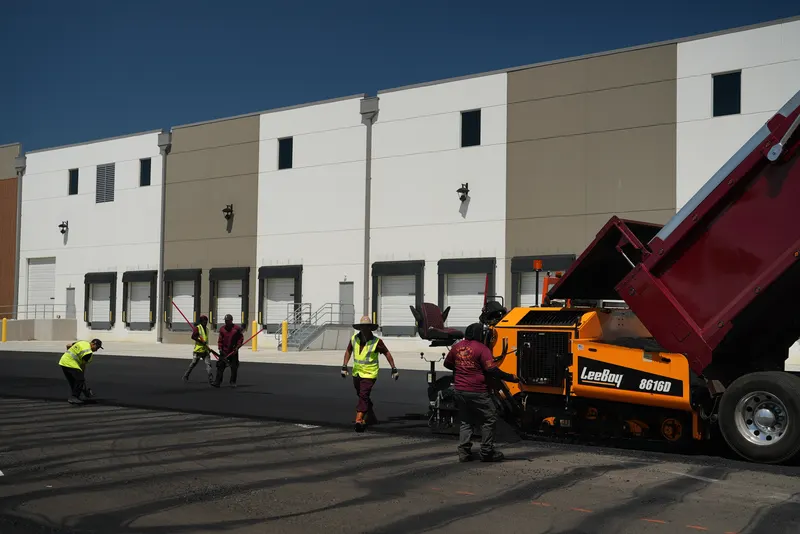
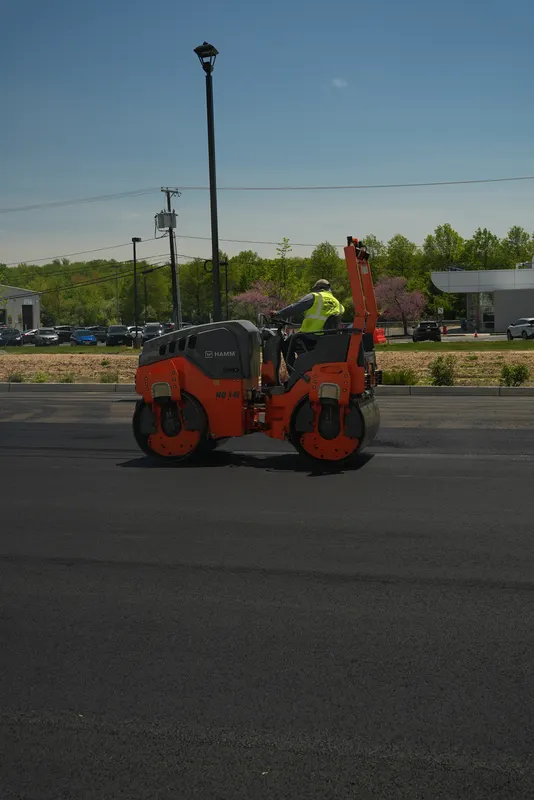
- Paving in lifts. The base course goes down with a paving machine and is rolled. The surface course follows, rolled to a tight, smooth finish. Joints are kept tight and straight.
- Edges and cleanup. Edges along curbs, islands and lawn areas are finished cleanly. We sweep, haul debris and leave the site ready to reopen.
- Walkthrough. We walk the lot with you or your manager and confirm everything in the proposal was done.
Thickness, drainage and timing
Commercial lots carry more weight and more turning traffic than a home driveway, so they are usually built with a thicker aggregate base and paved in two lifts. Truck routes, loading areas and dumpster pads may need more depth again. We size each area to its use.
Drainage drives the life of a lot. Water that sits on asphalt or seeps under the edges softens the base, and that is where holes and broken areas start. Good pitch toward inlets and off the pavement matters as much as the asphalt itself. Our article on why proper drainage is important for your parking lot explains why.
Paving runs in New Jersey from roughly spring into late fall, when temperatures allow hot asphalt to compact properly. Many lots can be phased over a few days. Larger lots or full reconstructions take longer, and we give you a realistic schedule up front.
What affects the cost of a parking lot
- Total area, and how it splits between mill-and-repave and reconstruction.
- Depth of milling and the amount of base repair needed.
- Grading or drainage corrections.
- Asphalt thickness and the number of lifts.
- Phasing requirements and working hours.
- Access for trucks and equipment.
Every lot is priced on site. Our how driveway jobs are priced covers how asphalt work is priced in general, and the proposal for your property will be specific to it. For planning help, see how to plan an asphalt parking lot paving project.
Working with boards and property managers
Parking lot decisions rarely rest with one person. A property manager may need to take a proposal to an owner, or an HOA board may need to compare several bids before a vote. We write proposals with that in mind: each area of the lot is described separately, with the type of work, the milling depth, the base repairs and the asphalt thickness, so a board can see what it is buying and compare bids on the same scope.
We can walk the property with a manager or board member, answer questions about why one area needs reconstruction while another only needs milling and repaving, and suggest a phased plan if the work needs to be spread over more than one budget year. Fixing the worst failed areas first and repaving the rest later is often a sensible way to protect the lot while the reserve catches up.
For a wider look at roads, HOA communities and municipal properties, see our commercial asphalt paving page.
Parking lots we serve
We pave parking lots throughout Monmouth County, Ocean County from Toms River north and southern Middlesex County, including properties in Eatontown, Tinton Falls, Lakewood, Edison, East Brunswick and Wall.
Questions about parking lot paving
Can you pave our lot without closing the whole property?
Often, yes. Many lots can be done in phases, with one section paved while another stays open for parking and deliveries. Whether that works depends on the layout, the entrances and how much room the equipment needs. We look at traffic flow during the estimate and propose a phasing plan you can share with tenants or residents.
How thick is the asphalt on a parking lot?
Commercial lots are usually built thicker than driveways and are typically paved in two lifts: a base course and a finer surface course on top. Areas that carry trucks, such as loading zones, dumpster pads and drive lanes, may need more. We size the base and asphalt to the traffic your lot actually carries rather than using one number for every job.
Should we repave the lot or rebuild it?
If the base is mostly sound and the problems are surface wear and scattered cracks, milling and repaving is often the most cost-effective choice. If large areas show alligator cracking, ruts or settled spots, the base underneath has failed, and those areas need to be dug out and rebuilt. Many lots end up with a mix of both.
When can cars park on a freshly paved lot?
Fresh asphalt needs time to cool and firm up before traffic returns. Passenger cars can usually use a new section within a day or so, depending on the weather, while trucks and heavy deliveries should wait longer. We give you a clear reopening plan for each phase so you can notify tenants, residents or customers ahead of time.
Do you work with HOA boards and property managers?
Yes. We regularly put together written proposals that a board or owner can review and compare, with the scope broken out by area. We can walk the property with a manager or board member, answer questions from the board, and schedule work in coordination with the management office.