When a commercial parking lot is worn out, property owners usually end up choosing between two approaches. One is milling and new paving: grind off the worn top layer and pave fresh asphalt in its place. The other is full-depth replacement: remove the pavement entirely, rebuild the base and pave a new lot from the ground up.
Both produce a lot that looks new on the last day. The difference shows up over the following years, and it comes down to one question: is the base under your asphalt still doing its job? This guide explains how each approach works, the signs that point one way or the other, and how many lots end up with a combination of both.
How milling and new paving works
A milling machine uses a rotating drum fitted with carbide teeth to grind the asphalt down to a set depth. The ground material, called millings, travels up a conveyor into a dump truck and is recycled. What is left is a clean, textured surface at a controlled height.
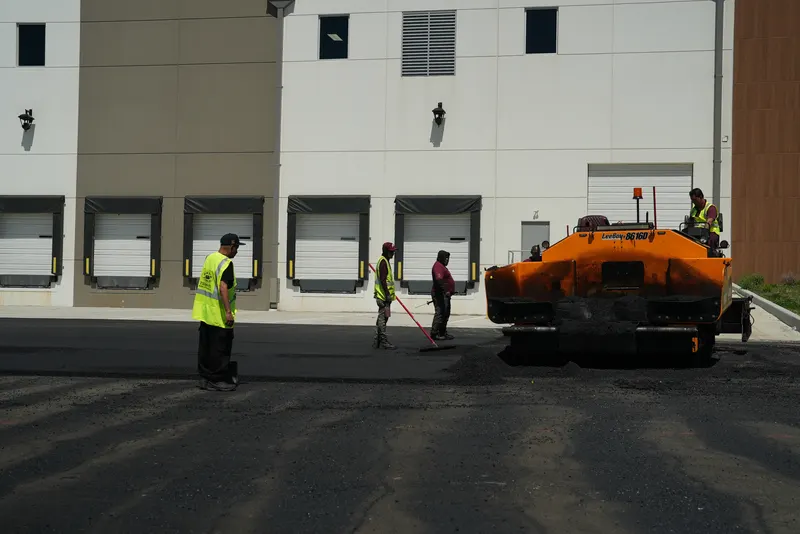
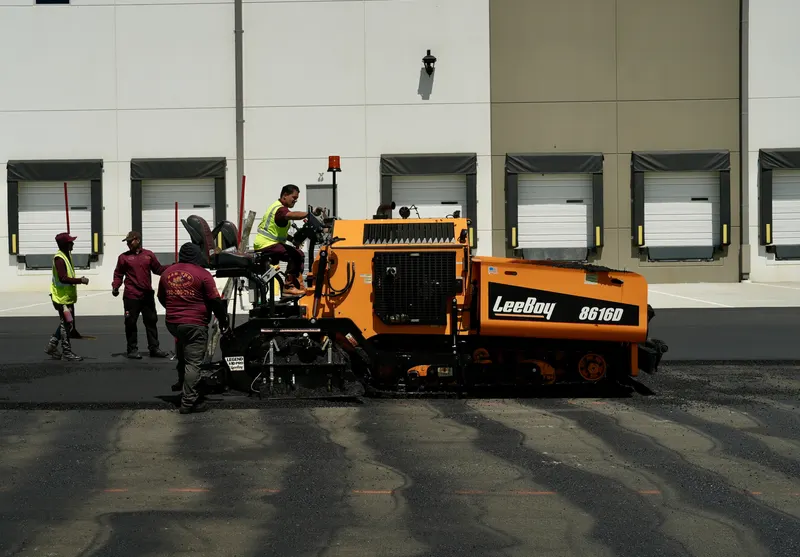
From there, the surface is swept, a tack coat is applied so the new asphalt bonds to the old, and fresh hot mix asphalt is placed with a paving machine and compacted with rollers.
Milling matters on a commercial lot because the lot is surrounded by fixed heights: curbs, sidewalks, building entrances, loading docks and drain inlets. Paving new asphalt without milling first raises the surface, which shrinks the curb reveal, changes how water reaches the inlets and creates a bump at every doorway. Milling keeps the finished surface at the right height everywhere it meets something else. Our asphalt milling page covers the process in more detail.
How full-depth replacement works
Full-depth replacement takes everything out. The existing asphalt is milled or excavated, and the crew digs down through the old base to firm ground. Soft or wet subgrade is removed and replaced, the subgrade is graded and compacted, and a new aggregate base is placed and compacted in layers. Then the lot is paved new, typically in two lifts: a base course for strength and a surface course for a smooth finish.
Because the whole structure is rebuilt, this is also the moment to change things that milling cannot: correct grades that send water the wrong way, build a heavier section for truck routes and loading areas, or rework how the lot drains.
When milling and new paving makes sense
Milling and new paving is the right fit when the base is still sound and the problems are mostly at the surface. Signs that point this way include:
- The surface is faded, rough or raveling, with loose stone on top.
- Cracks are mostly individual lines rather than interconnected patterns.
- The lot holds its shape: no ruts in the drive lanes, no sunken areas.
- Water drains reasonably well, with only minor low spots.
In these cases, rebuilding the base would be spending money on a structure that does not need it. Milling off the worn top and paving a fresh surface course renews the lot, keeps every transition at the right height, and recycles the old material.
When full-depth replacement is the answer
When the base has failed, new asphalt on top will only hide the problem for a while. The same failures tend to come back through the new surface, because nothing underneath has changed. Signs that point to full-depth replacement include:
- Interconnected cracking, often called alligator cracking, spread across large areas of the lot.
- Ruts and depressions in drive lanes and parking spaces, especially where trucks travel.
- Areas that move or flex under heavy vehicles.
- Water that ponds in the same places after every storm, or a lot that never drained properly to begin with.
- A lot built for lighter traffic than it now carries, such as a property that has started taking regular truck deliveries.
When those conditions run across most of the lot, full-depth replacement is usually the better long-term choice.
The common middle ground
Few commercial lots fall neatly into one category. More often, the parking stalls are in decent shape while the entrance, the main drive lane and the area around the dumpster enclosure have failed.
That is why many projects combine the two approaches. The failed areas are excavated and rebuilt full depth with new base and asphalt, then the whole lot is milled and paved with a new surface course so it finishes as one smooth, continuous surface at the right heights. The money goes into rebuilding where the structure has failed, and milling keeps everything else at the right height.
A good proposal for this kind of job maps it out area by area, so you can see where the base is being rebuilt, where the surface is being milled, how deep, and how thick the new asphalt will be in each zone.
How a contractor should decide
The decision should come from what is happening on your lot, not from a habit of always recommending one approach. A thorough site assessment looks at:
- The type and pattern of cracking across the lot.
- Ruts, settlement and soft areas, especially in truck routes.
- Drainage: where water collects and whether inlets sit at the right height.
- Current traffic, and any change in how the lot will be used.
- Fixed heights at curbs, doors, docks and inlets that the finished surface has to meet.
Ask the contractor to walk the lot with you and point out what they see. If they recommend full-depth work in some areas, they should be able to show you why. If they recommend milling and new paving across the board, ask how they know the base will hold up.
Planning around the business
Either approach can usually be phased so the property stays open. Milling and paving tends to move faster, and sections can often reopen quickly once the asphalt has cooled. Full-depth work takes longer per section because of the excavation and base work, so phasing and traffic plans matter even more. Our guide to asphalt parking lot paving for NJ businesses covers phasing and keeping customers and deliveries moving in more detail. For how we plan milling and new paving around business hours on different kinds of properties, see commercial asphalt paving.
Get an honest assessment of your lot
Dan The Paver mills, rebuilds and paves asphalt parking lots for businesses, HOAs and property managers. Dan walks every lot himself and tells you plainly whether milling and new paving will hold up or whether the base needs to be rebuilt, area by area. Learn more on our parking lot paving and commercial paving pages.
We work across Monmouth County, Ocean County from Toms River north and southern Middlesex County. Request a free quote or call 732-403-3053 to set up a site visit.
Need this done right?
Dan The Paver handles parking lot paving across Monmouth, Ocean (Toms River and north) and southern Middlesex counties. Free on-site estimates.