For most businesses, the parking lot is the first thing customers, tenants and delivery drivers touch. When it is built well, nobody thinks about it. When it is not, it shows up as standing water at the entrance, broken pavement in the drive lanes and complaints from the people you most want to keep happy.
This guide is for owners, facility managers and property managers in Monmouth, northern Ocean and southern Middlesex counties who are planning one of two projects: a new asphalt parking lot, or a full replacement of a lot that is past saving. Both come down to the same fundamentals: a solid base, good drainage, the right pavement for the traffic, and a plan that keeps the business running while the work gets done.
New lot or full replacement?
A new lot is built where there was no pavement before: a new building, an expansion onto open ground, or a gravel area being converted to asphalt. A full replacement removes the existing pavement entirely and rebuilds the lot from the base up.
Full replacement is the right call when the problems go deeper than the surface. Signs include widespread cracking in an interlocking pattern, ruts in the drive lanes, areas that sink or shift under trucks, and water that sits in the same low spots after every storm. Those usually point to a base that has failed or was never built for the loads it carries.
If the base is still sound and the wear is mostly on top, milling off the worn surface and paving new asphalt may be enough. We compare the two approaches in milling vs. full-depth replacement for commercial lots. An honest assessment on site is the only way to know which side of the line your lot is on.
Start with how the lot is used
The most useful thing you can tell a paving contractor is how the property actually works day to day. That includes:
- Who parks there: customers, employees, residents or a mix.
- What drives through: cars only, or also box trucks, tractor-trailers, garbage trucks and buses.
- Where heavy vehicles go: loading docks, dumpster enclosures, fire lanes and the routes trucks take to reach them.
- When the lot is busiest: business hours, shift changes, deliveries and weekends.
That information drives the design. A parking area that only sees cars needs far less structure than a truck route or a loading zone. Rather than paving the entire site to one thickness, a well-planned lot puts a heavier pavement section where the heavy loads are, and that is where the budget should go.
Drainage comes first
On a parking lot, water is the main enemy. Every square foot of asphalt sheds rain, and all of it has to go somewhere. When grades are wrong, water ponds in parking spaces, runs toward building entrances or sits along curbs, and it slowly works its way into the base.
A new lot or full replacement is the best opportunity to get drainage right. Grades are set so water moves across the surface to inlets, swales or the edge of the pavement without collecting along the way. Inlets are set at the correct height relative to the finished asphalt, and runoff from roof leaders and landscaped areas gets a defined path off the pavement. On a replacement, problem areas you already know about, such as the corner that floods every storm, should be part of the conversation from the first site visit.
The pavement structure
A commercial lot is built in layers, and each one has a job.
Subgrade
The native soil is the foundation for everything above it. Soft, wet or organic material is excavated and replaced, and the subgrade is graded and compacted to the slopes the finished lot will follow.
Aggregate base
A compacted stone base, often dense-graded aggregate or recycled asphalt millings where suitable, carries the load and spreads it into the ground. Commercial lots usually get a thicker base than driveways, and truck areas get more still.
Asphalt in two lifts
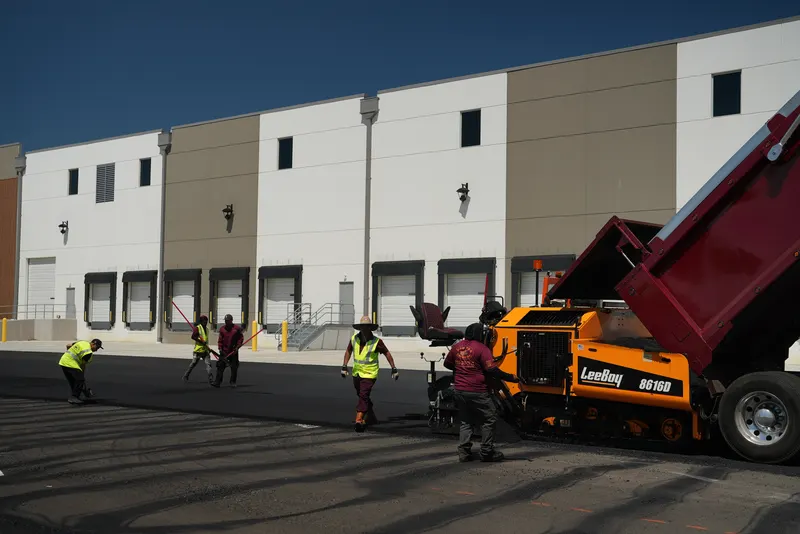
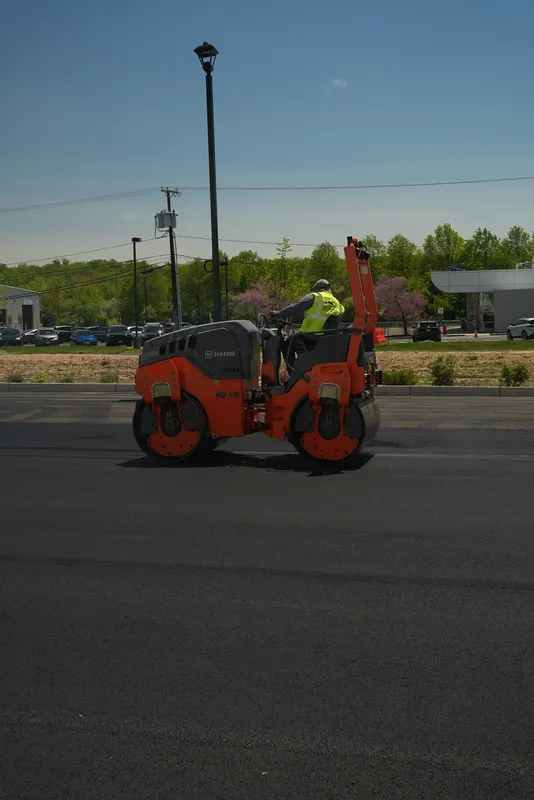
Commercial lots are typically paved in two lifts: a coarser base course for strength, and a finer surface course on top for a smooth, tight finish. Each lift is placed with a paving machine and compacted with rollers while it is hot. Building in lifts gives the pavement more strength than a single layer of the same total thickness and gives a cleaner final surface.
Approvals and site requirements
Depending on the project, a new lot or a significant change to an existing one can involve municipal site plan or zoning review, especially when it adds paved area or changes how stormwater leaves the property. In New Jersey, projects that disturb larger areas of soil may also need a soil erosion and sediment control plan certified by the county soil conservation district, and larger developments can fall under state stormwater rules.
These approvals are usually handled by the owner, often with a civil engineer, before paving starts. If you already have engineered plans, a paving contractor builds to them. If you do not, ask your town early what applies to your project so the schedule is not held up later.
Keeping the business open
The hardest part of commercial paving is often not the asphalt. It is keeping customers, tenants and deliveries moving while part of the lot is closed.
Many lots can be done in phases, with one section paved while another stays open. A good phasing plan answers a few questions in writing before work starts: which entrances stay open, where people park in the meantime, when trucks can reach loading areas, and how long each section stays closed after it is paved. Work zones are closed off with cones and barricades, and the schedule gives you time to notify tenants, staff or residents in advance.
Retail and office properties often prefer work early in the week or outside business hours. Warehouses usually need dock access protected. HOAs and apartment communities need clear notice for residents about where to park their cars. Planning around those needs is part of the job, not an afterthought. Our commercial paving page explains how we schedule work for retail, office, industrial, church, school and HOA properties.
What to look for in a commercial proposal
A useful proposal for a new lot or full replacement should separate the work area by area and spell out:
- Removal and excavation, including how old material is handled or recycled.
- Base material and thickness, with heavier sections called out for truck areas.
- Asphalt thickness and the number of lifts.
- Drainage corrections, grades and inlet adjustments.
- Phasing, work hours and how traffic will be managed.
- Cleanup and a final walkthrough with your representative.
If two proposals describe different pavement sections for the same lot, ask why. The answers will tell you a lot about who has actually looked at how your property is used.
Plan your lot with Dan The Paver
Dan The Paver builds and replaces asphalt parking lots for businesses, HOAs and property managers. We are family-owned, licensed and insured (NJ HIC #13VH03282800), and Dan walks every property himself to plan the work around how it is used. See our parking lot paving and commercial paving pages for more on how we work.
We take on commercial work across Monmouth County, Ocean County from Toms River north and southern Middlesex County. Request a free quote or call 732-403-3053 to schedule a site visit.
Need this done right?
Dan The Paver handles parking lot paving across Monmouth, Ocean (Toms River and north) and southern Middlesex counties. Free on-site estimates.