Paving partner for builders and developers
New neighborhoods need roads before they need anything else. Buyers, framers, plumbers and concrete trucks all arrive over the streets, and the finished roads are what the township, the HOA and every future homeowner will judge the development by. Dan The Paver paves asphalt roads and streets for builders and developers across New Jersey, from short cul-de-sac streets with a handful of lots to longer subdivision roads that open in phases.
We focus on what we do best: asphalt paving and milling. Utilities, curbing and drainage structures are handled by your site contractor, and we coordinate with them and with your site engineer so each layer of asphalt goes down at the right time and to the right grade.
What we pave for builders
- New neighborhood roads and streets. Through streets, loop roads and entrance roads that connect the development to the town road.
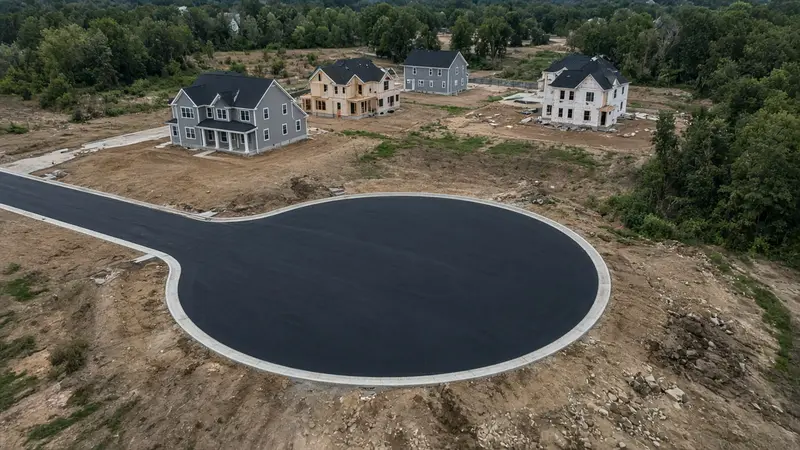
- Cul-de-sacs and turnarounds. Bulbs and hammerheads sized for emergency vehicles and trash trucks, graded so water runs to the inlets instead of collecting in the middle of the circle.
- Base course paving. The first, structural layer of asphalt that carries construction traffic during the build-out.
- Top course paving. The final wearing surface, paved once heavy construction is finished.
- Milling. Removing asphalt along curbs and tie-ins so the finished road meets curbs, inlets and the existing street at the right height. See our asphalt milling page for more on how milling works.
- Driveway aprons and tie-ins. The short connections between the new road and each lot, plus the joint where the new road meets the existing town road.
If the development includes a clubhouse lot, a community parking area or a commercial pad, those are covered on our commercial paving and parking lot paving pages. Homebuyers who want their own driveway done can see asphalt driveway paving.
Base course and top course, explained
Subdivision roads are almost always paved in at least two layers, and the timing between them matters as much as the asphalt itself.
Base course
Once the stone base is in place, fine-graded and approved, the base course is paved. Depending on how the job is split, we either build and grade the aggregate base or pave over the base your site contractor installs after it has been proof-rolled and approved by the engineer. The base course is the structural layer. It gives the development a solid, drivable road for the months of construction ahead, keeps mud off the stone base, and protects the subgrade from water.
Living with the base course
While homes are going up, the base course takes a beating from loaded concrete trucks, dumpsters, lumber deliveries and equipment. That is expected, and it is exactly why the top course waits. Structure frames and manhole covers sit slightly above the base course during this period, so they can be set to final grade later.
Top course
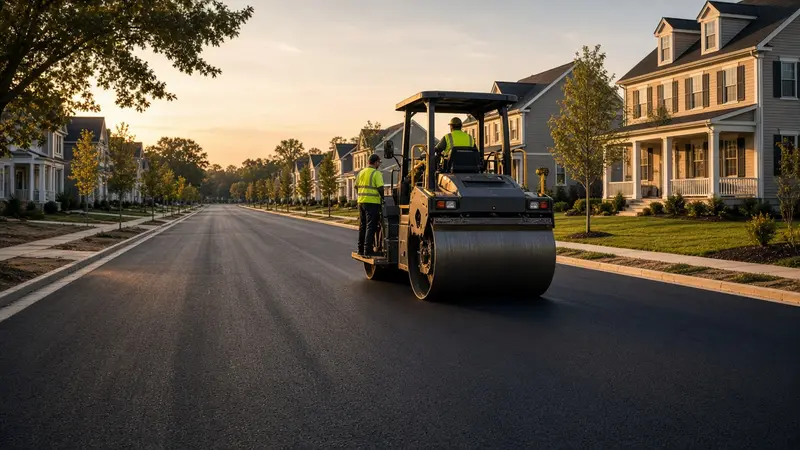
Near the end of the build-out, usually once most homes are finished, the road is prepared for the top course. Sections damaged by construction traffic are cut out and replaced, frames are adjusted to final grade, edges are milled where needed, and the surface is cleaned and tacked so the layers bond. Then the top course is placed with a paving machine and compacted with rollers, giving the neighborhood a smooth, even finished street.
Working with your schedule and your site engineer
Builders run on schedules, and paving has to fit into a long chain of trades. We plan the work around your milestones rather than our own convenience:
- Plan review. We work from your approved site plans and paving details: road widths, cross slopes, profiles, thicknesses and mix types.
- Coordination with the site contractor. Base course cannot go down until curbs, utilities and the stone base are complete. We stay in contact with your site contractor so the crew arrives when the road is actually ready.
- Inspections. Roads that will be dedicated to the township, or turned over to an HOA, are usually inspected at key points. We schedule paving around the inspections your engineer and the municipality require, and we pave to the approved grades and thicknesses.
- Clear communication. You get a straight answer about when we can be there, what has to be finished first, and how long each section will be closed.
Phased paving for larger developments
Many developments are built in sections. The roads in the first section may need their top course while lots in the last section are still being cleared. We can phase the paving the same way:
- Base course by section, as each section’s curbs, utilities and stone base are completed.
- Top course by section, as construction in that section winds down and the road is ready for its final surface.
- Final tie-ins, where sections meet each other and where the development meets the existing town road, so the joints are tight and smooth.
Phasing keeps finished sections looking finished for the homeowners who have already moved in, while the rest of the development keeps building.
Drainage and grades come first
A new road that holds water will not last. Before any asphalt goes down, we check that the grades will carry water to the curb line and the inlets the engineer designed. Crown and cross slope are set so water sheds off the travel lanes, cul-de-sacs are pitched toward their inlets, and the finished surface meets curbs and frames at the right height. Getting the grades right is what keeps a subdivision road from developing low spots and standing water after the first winter.
Why builders work with a family-owned paver
When a builder calls Dan The Paver, they talk to Dan. He walks the site, reviews the plans, and is the person you call when the schedule moves. We are a licensed and insured New Jersey contractor (NJ HIC #13VH03282800), and every job is scoped in writing so your project manager knows exactly what is included: base course, top course, milling, tie-ins and aprons.
We also understand that the road is part of what sells the homes. A clean, well-compacted street with tidy edges and smooth tie-ins is one of the first things a buyer sees when they drive into a new neighborhood.
Where we pave subdivision roads
We take on road and street paving for builders throughout Monmouth County, in Ocean County from Toms River north, and in southern Middlesex County. That includes growing towns such as Howell, Jackson, Manalapan, Monroe and Toms River.
Get a proposal for your development
Send us the site plan and paving details, tell us where the project stands, and we will set up a time to walk the site. Call or text 732-403-3053, use the quote form below and choose Road / subdivision (builder), or reach us through the contact page. For a look at everything we do, see our full list of asphalt paving services.
Questions builders ask
Do you pave roads in new subdivisions for builders?
Yes. Dan paves roads and streets for builders in new neighborhoods, including through streets, cul-de-sacs, entrance roads and the driveway aprons that tie into them. We work from your approved plans and coordinate with your site contractor and engineer so the paving fits the rest of the site work.
Can you pave the base course now and the top course later?
Yes, and on most subdivisions that is the normal approach. The base course goes down once curbs, utilities and the stone base are in, so crews and deliveries have a solid road during construction. The top course is paved near the end of the build-out, after the heavy construction traffic is finished, so the finished surface goes down clean.
Do you work to the township or engineer's specifications?
Yes. Roads that will be dedicated to the town, or that an HOA will take over, are usually built to a specification set by the approving board and checked by the municipal or project engineer. We pave to the thicknesses, mixes and grades on the approved plans and schedule around the inspections your engineer and the township require.
What happens to the base course before the top course goes down?
Before the top course, the base course is cleaned and inspected. Sections damaged by construction traffic are cut out and replaced, structure frames are set to final grade, and edges along the curb are milled where the finished height needs it. A tack coat is applied so the two layers bond, and then the top course is paved and rolled.
Can you work in phases as sections of the development open?
Yes. Larger developments are often built in sections, and the paving can follow the same phasing. We can pave base course in one section while homes are still going up in another, and come back for top course section by section as each one is ready for final paving.
How do I get a proposal for a subdivision paving job?
Call or text Dan at 732-403-3053 or use the quote form on this page and choose Road / subdivision (builder) as the project type. Sending the site plan and paving details from your engineer up front is the fastest way to get a written proposal that matches your specification.