Who this page is for
This page is for homeowners who need a new asphalt driveway, or whose current one is past saving. Maybe the surface has broken into a web of alligator cracks, the base has sunk into ruts where the cars park, water pools in front of the garage, or the driveway was simply never built right. If that sounds familiar, a properly built driveway is the fix, not another quick cover-up.
We are a family-owned asphalt paving company, and residential driveways are half of what we do. If you are comparing contractors for asphalt driveway paving in NJ, the questions that matter most are how the base is built, how thick the asphalt is, and how the edges and tie-ins are finished. This page answers all three.
Asphalt, which many people call blacktop, is a popular driveway surface in central New Jersey for good reasons. It flexes through freeze-thaw cycles, it can be driven on within days, and when it wears, it can often be milled and repaved instead of torn out down to the dirt. Built on the right base, it gives you a long service life for the money.
What we install
- New driveways on new construction, or where there was only gravel or dirt before.
- Full replacements, where the old asphalt comes out and the base is rebuilt from the ground up.
- Repaving, either a full tear-out or milling off the worn top and paving fresh asphalt where the existing base is still sound. We decide which one fits during the estimate, after checking the base.
- Widening and extensions, such as an added parking spot or a second lane. See driveway widening and extensions.
- Milling and full-depth base repair when they are part of getting the driveway right, for example milling along the garage entry so the new surface meets it at the correct height.
How a driveway job goes, step by step
1. Free estimate on site
We walk the driveway with you, measure it, check how water moves across the property, look for soft spots and talk through the layout. You get a written quote that says what is being removed, how the base will be handled and how much asphalt is going down.
2. Removal and excavation
On a replacement, the old asphalt comes up with an excavator or a milling machine. Clean millings can be recycled as base material, which our asphalt milling page covers in more detail. Then we dig to the depth the new base needs and take out any soft, organic or wet soil we find.
3. Grading and base
This is where driveways succeed or fail. We grade the ground so water runs away from the house and garage and off the edges instead of sitting on the surface. Then we spread a compacted aggregate base, typically dense-graded quarry process (QP) or recycled asphalt, shaped to the same pitch.
4. Compaction
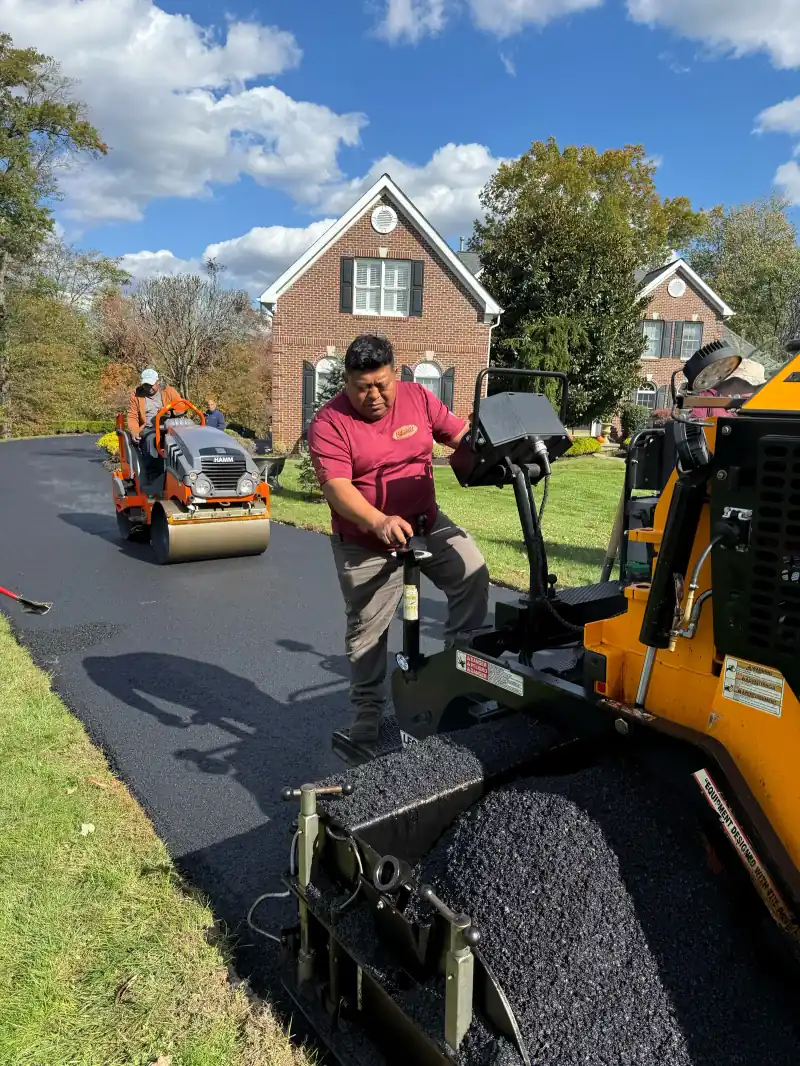
The base is compacted with a vibratory roller and plate compactor until it is firm and does not move. A base that gives under a loaded truck will give under your car, and that is how ruts and sunken spots start.
5. Paving
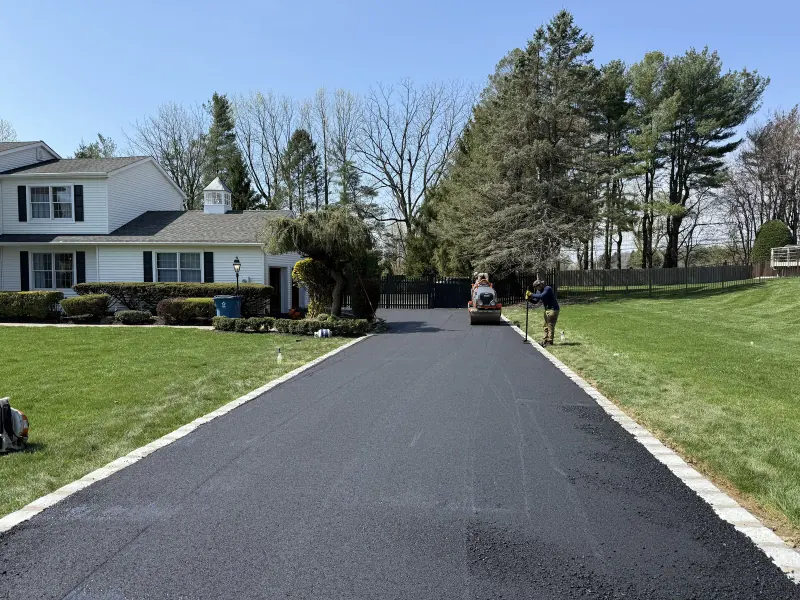
Hot mix asphalt is placed with a paving machine so the mat goes down at an even thickness and temperature, then rolled while it is still hot. For most homes that means roughly 2 to 3 inches of compacted asphalt. Hand work is kept to the spots the machine cannot reach, like tight corners by the garage.
6. Edges, tie-ins and cleanup
We cut clean joints where the new driveway meets the street, the walkway or the garage so there is no trip lip or bump. Edges are tapered and backed with soil so they hold their shape. Then we clean up, haul off debris and leave the site the way we found it, minus the old driveway.
7. Final walkthrough
We walk the finished driveway with you, go over cure time and care, and answer any questions before we leave.
Base, thickness and timing in plain terms
Every contractor says they build a good base. Here is what that means. A typical residential driveway gets about 2 to 3 inches of compacted asphalt over a compacted aggregate base that is usually thicker than the asphalt itself. Clay-heavy soil, poor drainage or heavy vehicles can call for a deeper base or more asphalt. Sandy soil closer to the shore drains well but still needs thorough compaction and solid edges.
Many driveways are finished in one to two days from removal to final rolling, depending on size, access and how much base work the ground needs. Larger or more involved jobs take longer. You can usually drive on a new driveway after a few days, and heavy vehicles should wait longer. Asphalt keeps curing for months, so it can scuff in hot weather early on.
Paving season in New Jersey runs roughly from spring into late fall, whenever air and ground temperatures let hot asphalt compact properly.
What affects the price
We do not publish a flat price because driveways vary too much. The main factors are:
- Size and shape: square footage, curves and turnaround areas.
- Tear-out: removing old asphalt or gravel, and how much material has to be hauled.
- Base condition: how much excavation and new aggregate the ground needs.
- Grading and drainage: correcting a pitch that sends water toward the house.
- Asphalt thickness: heavier vehicles mean more material.
- Access: tight lots, long runs and steep grades take more time.
- Tie-ins: aprons, garage entries and joints at the street.
Our how driveway jobs are priced goes through each of these in more detail, and the estimate itself is free.
Why homeowners call Dan The Paver
- Family-owned, licensed and insured, NJ HIC #13VH03282800.
- You talk directly with the people responsible for your job.
- We explain what your driveway actually needs, including when a less expensive option makes more sense.
- Asphalt driveways and parking lots are all we do, so our equipment and crew are set up for exactly this kind of work.
Before your estimate, it helps to read what to do before installing a new driveway, our practical guide to installing an asphalt driveway and why asphalt is a good driveway choice.
Where we pave driveways
We install asphalt driveways across Monmouth County, Ocean County from Toms River north and southern Middlesex County. That includes homeowners in Freehold, Howell, Marlboro, Toms River, Brick and Old Bridge, along with the towns around them.
Questions about asphalt driveway paving
How thick should a new asphalt driveway be?
For most homes, a residential driveway is paved with roughly 2 to 3 inches of compacted asphalt over a compacted aggregate base. The right numbers depend on your soil, your drainage and what parks on the driveway. If you keep a work truck, camper or boat at home, tell us during the estimate and we will plan the base and asphalt for that load.
How soon can I drive on my new driveway?
Plan on keeping cars off for the first few days, and keep heavy vehicles such as moving trucks, dumpsters and campers off longer. Fresh asphalt stays soft while it cures, especially in hot weather, so avoid turning the steering wheel while the car is stopped, and keep kickstands, jack stands and trailer tongues off the surface for the first few weeks.
Do you remove my old driveway?
Yes, when the job calls for it. On a full replacement we excavate or mill out the old asphalt, haul it away or recycle it, fix soft spots in the ground and rebuild the base before paving. If your existing driveway is still structurally sound, milling off the worn top and repaving may be the better value, and we will tell you that during the estimate.
When is paving season in New Jersey?
Asphalt goes down hot and needs reasonable air and ground temperatures to compact properly, so paving season in New Jersey generally runs from spring into late fall. Spring and early summer calendars fill quickly, so it helps to book your estimate early. We do not pave on frozen ground or in the rain.
Do I need a permit for a new driveway?
It depends on your town and the scope of work. Widening a curb cut, changing the driveway apron or adding paved area can involve the municipal construction or zoning office, and many towns limit impervious coverage on a lot. Check with your town before work starts. We are happy to talk through the layout so you know what to ask.