A new asphalt driveway or parking lot is something you should only have to buy once in a long while. The contractor you choose decides whether that happens. Most of what makes asphalt last is buried under the surface, so two jobs can look identical on the day the crew leaves and perform very differently a few winters later.
Whether you own a home in Freehold or Middletown or manage a commercial property along Route 9 or Route 35, the process of choosing a contractor is the same. This guide covers the questions worth asking, what a good quote should include and the red flags that should make you walk away.
Check the basics first
New Jersey registration
New Jersey requires home improvement contractors to register with the Division of Consumer Affairs, and residential paving falls under that law. A registered contractor has a registration number, and it should appear on their estimates, contracts and advertising. Ask for it, then look it up on the Division of Consumer Affairs website. It takes a couple of minutes and confirms you are dealing with a real, registered business.
Ours is NJ HIC #13VH03282800, and it is printed in the footer of every page on this site.
Insurance
Paving involves heavy equipment, dump trucks and hot material on your property. Ask for proof of liability insurance, and on commercial work, ask for a certificate of insurance naming your company or association if your policy requires it. A contractor who hesitates to provide it is telling you something.
A real local presence
Look for a contractor who works in your area regularly and can be reached when you need them. A working phone number, a business you can look up and reviews you can read are basic signs of a company that plans to be around after your job is finished.
Questions to ask during the estimate
The estimate visit is your best chance to judge a contractor. A good one walks the property, measures, looks at drainage and asks how the driveway or lot is used. These questions help you find out how they build.
“What happens to the old pavement?”
On a replacement, the old asphalt should be fully removed or milled, not paved over. Ask how it will be taken out and whether the material is hauled away or recycled.
“How will you prepare the base?”
This is the most important question. Listen for specifics: how deep they will excavate, what they will do if they find soft soil, what base material they use, and how they compact it. Vague answers like “we’ll make it nice and solid” are not enough. Our post on what goes into a new asphalt driveway installation explains each layer, so you know what a complete answer sounds like.
“Where will the water go?”
Drainage is the main reason pavement fails early. A good contractor should be able to explain how the finished surface will shed water away from your house, garage or building, and how they will correct any spots where water collects now.
“How thick will the asphalt be after compaction?”
Thickness should be stated in the quote as a compacted figure. On commercial lots, ask how many lifts will be placed and whether truck routes and loading areas get a heavier section than the parking stalls.
“Will you use a paving machine?”
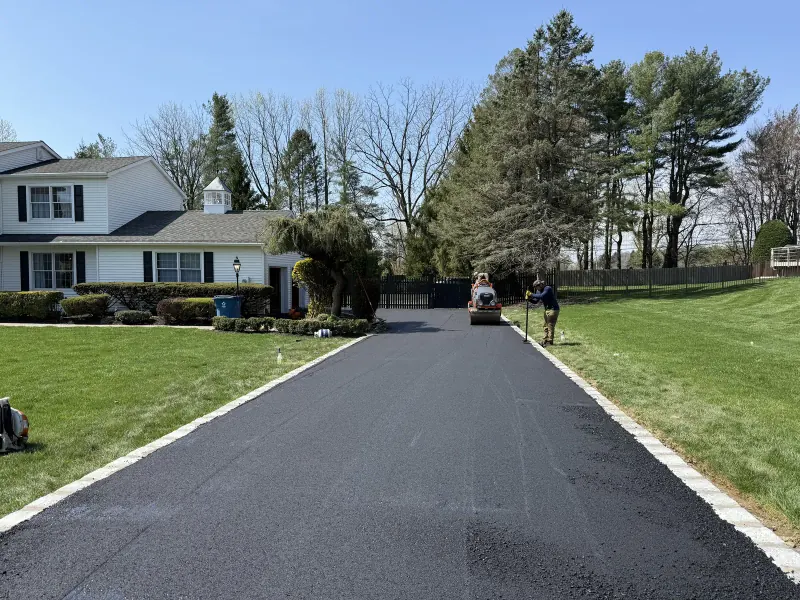
On most jobs, asphalt placed with a paving machine goes down at a more even thickness and temperature than asphalt spread by hand. Hand work should be limited to tight spots the machine cannot reach.
“Who will be on my job?”
Ask who you will talk to during the project and who will be on site when the crew paves. Knowing that the person who gave you the estimate is responsible for the work makes a real difference if a question comes up.
What a good quote includes
A written quote should describe the job clearly enough that you could compare it line by line with another one. Look for:
- The area being paved and any changes to layout or width.
- Removal and excavation of the existing surface.
- Base material, thickness and compaction.
- Grading and any drainage corrections.
- Compacted asphalt thickness, and the number of lifts on commercial work.
- How transitions at the street, garage, walkways, curbs and inlets will be finished.
- Cleanup and hauling.
New Jersey law requires most home improvement contracts to be in writing and to include the contractor’s registration number, along with a notice of your right to cancel within three business days. If a contractor wants to start on a handshake, that is a problem.
When you compare quotes, compare the scope, not just the bottom line. A lower number often means less excavation, a thinner base or less asphalt. Our page on how paving jobs are priced explains the factors that legitimately change the scope of a job.
Red flags to watch for
Some warning signs come up again and again in consumer complaints about paving:
- “Leftover asphalt from a job down the street.” Door-to-door crews offering a fast deal on extra material are a well-known scam. The asphalt is often thin, with no real base work, and laid right over whatever is there.
- Pressure to decide on the spot. A legitimate contractor gives you a written quote and time to think it over.
- Large cash payments up front, especially before any work or materials are scheduled.
- No registration number on the quote or contract, or reluctance to provide it.
- Vague answers about the base, or an offer to pave directly over a failed surface.
- No written contract, or a contract that leaves out thickness, base and scope.
- No local reviews or business information you can check.
For commercial properties and HOAs
Commercial work adds a few more questions. Ask how the contractor will phase the job to keep entrances, parking and deliveries working, and ask for the schedule in writing so you can notify tenants or residents. Ask whether they recommend milling and new paving or full-depth reconstruction, and why. Our guides to parking lot paving for NJ businesses and milling vs. full-depth replacement cover both in detail.
Talk to Dan The Paver
Dan The Paver is a family-owned asphalt paving company, licensed and insured in New Jersey. Dan comes out for the estimate himself, answers every question on this list, and puts the scope in writing. Read more about us, or see our asphalt driveway paving and parking lot paving services.
We work throughout Monmouth County, including Freehold, Middletown, Howell, Marlboro and Wall, as well as Ocean County from Toms River north and southern Middlesex County. Request a free quote or call or text 732-403-3053.
Need this done right?
Dan The Paver handles asphalt driveway paving across Monmouth, Ocean (Toms River and north) and southern Middlesex counties. Free on-site estimates.