A new asphalt driveway looks simple when it is finished: a smooth black surface with clean edges. What decides whether it stays that way is almost entirely hidden. The digging, the base stone, the compaction and the way water is handled all happen before the first load of hot asphalt shows up, and you never see them again.
If you are planning a new driveway in Monmouth County, northern Ocean County or southern Middlesex County, this guide explains each layer of the job, why it matters on New Jersey soil, and what a written quote should spell out so you can compare contractors fairly.
Start with what the driveway has to carry
Before anything is dug, a good contractor asks how the driveway will be used. Two family cars are one thing. A contractor’s pickup, a box truck that comes home at night, a boat trailer or a camper parked along the side are another. Heavier loads call for a deeper base and, in some cases, more asphalt.
Layout matters too. A new driveway is the easiest moment to fix what bothers you about the old one: add a parking spot, widen a single lane to two, square up a turnaround or soften a tight curve. If you are thinking about extra width, our page on driveway widening and extensions covers how that is built so the new section and the original area perform the same.
Finally, check with your town. Changes to the curb cut, the apron at the street or the total paved area on the lot can involve the municipal construction or zoning office, and many towns limit impervious coverage. It is far easier to sort that out before the estimate than in the middle of the job.
Step 1: Excavation and removal
On a replacement, the old driveway comes out first. Depending on the job, that means breaking it up and loading it with an excavator or skid steer, or grinding it off with a milling machine. Clean millings can be recycled, and where it suits the job they go back in as base material. Our asphalt milling page explains how that works.
On new construction or a former gravel driveway, excavation means digging down to the depth the new base needs. Either way, this is where the crew finds out what the ground is really like. Topsoil, roots, wet clay and organic material do not belong under a driveway, because they compress and shift over time. Anything soft is dug out and replaced, not paved over.
Step 2: Grading for drainage
Water is the main reason driveways fail early. When it sits on the surface or soaks into the base, it weakens the support under the asphalt, and New Jersey’s freeze-thaw cycles make that worse every winter.
Grading is the step that prevents it. The ground is shaped so water runs away from the house and garage and off the edges of the driveway, toward the lawn or the street, instead of collecting in the middle or along the garage door. If your current driveway sends water toward the house or has a low spot that holds a puddle after every storm, a new installation is the time to correct it, before any stone is placed.
Step 3: Building the base
The base is the structural layer of the driveway. It is usually a dense-graded aggregate, often called quarry process or QP in New Jersey, or recycled asphalt millings where they fit. It carries the weight of your vehicles and spreads it out into the ground underneath.
Two things matter most here: thickness and how well it is compacted. The base under a residential driveway is usually thicker than the asphalt on top of it, and it gets deeper where the soil is weak or the loads are heavy. Soil conditions vary a lot across our service area. Sandier ground near the shore drains well but still needs thorough compaction and well-supported edges. Heavier, clay-rich soil inland holds water and can call for more excavation and more stone.
The base is also shaped to the same pitch the finished driveway will have. If the stone is graded correctly, the asphalt on top follows it and water drains the way it should.
Step 4: Compaction
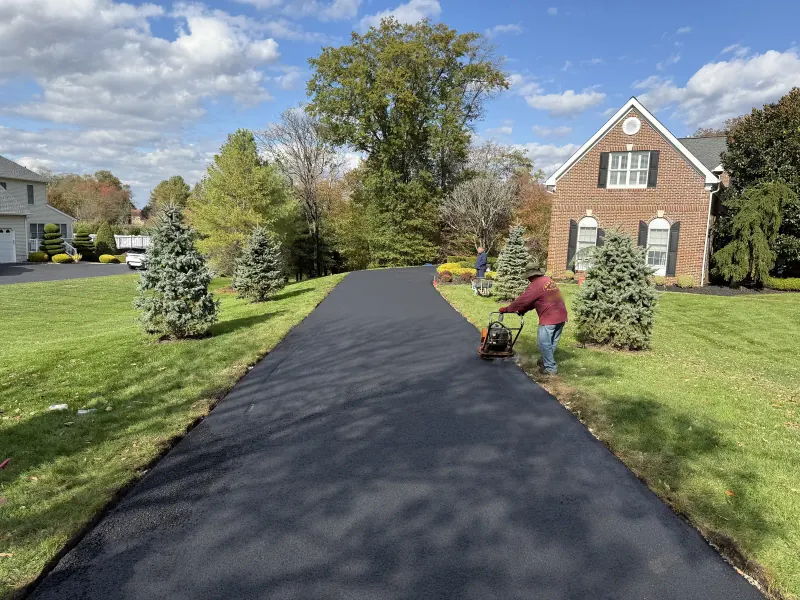
Loose stone is not a base. It becomes one when it is compacted with a vibratory roller and plate compactor until it is firm and does not move underfoot or under equipment. Edges and tight spots near the garage and walkways get the same attention as the open areas.
This step is easy to rush, and it is where many problems start. A base that gives under a loaded truck will give under your car, too, and over a season or two that shows up as ruts in the tire paths and sunken spots where the car parks. A properly compacted base is the single biggest factor in how long a driveway lasts.
Step 5: Paving and rolling
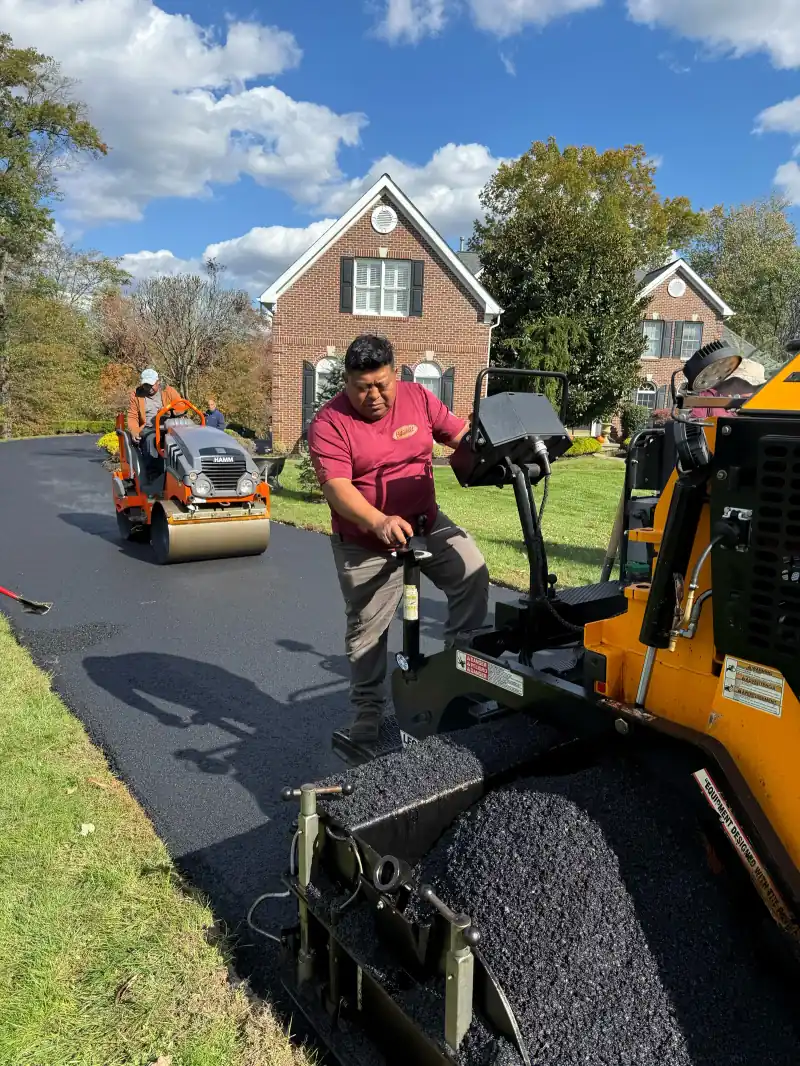
With the base ready, hot mix asphalt arrives from the plant in dump trucks and is placed with a paving machine. A machine puts the asphalt down at an even thickness and temperature, which gives a more consistent result than spreading it by hand. Hand work with rakes and lutes is kept to the places the machine cannot reach, such as tight corners at the garage.
Timing matters because asphalt has to be compacted while it is still hot. Rollers follow close behind the paver, pressing the mat tight and smooth. For most homes that means roughly 2 to 3 inches of compacted asphalt, with more where heavy vehicles park.
Step 6: Edges, tie-ins and walkthrough
The finishing details are what you notice every day. Where the new driveway meets the street, the garage floor and the walkway, the joints should be clean and flush, with no lip to trip on or bump to drive over. The outside edges are tapered and backed with soil once the asphalt cools, so they hold their shape instead of crumbling.
At the end of the job, a good contractor walks the driveway with you, checks the transitions and drainage, and explains how long to keep cars off while the asphalt cures. You can read more about that first stretch in our practical guide to installing an asphalt driveway.
What a written quote should spell out
Because so much of the work is buried, two quotes can look similar while describing very different driveways. Before you compare them, make sure each one answers these questions:
- Removal: Is the old driveway being fully removed, and where does the material go?
- Excavation: How deep will the crew dig, and what happens if soft soil turns up?
- Base: What material is going down, how thick, and how will it be compacted?
- Grading: Where will water drain when the job is done?
- Asphalt: How thick will the compacted asphalt be, and will it be placed with a paving machine?
- Tie-ins: How will the street, garage and walkway transitions be finished?
- Cleanup: Is hauling and final cleanup included?
If a quote is vague on these points, ask. A contractor who builds driveways properly is usually happy to explain what is underneath. Every driveway is priced on its own size, soil and scope, which is why we do not publish flat prices. Our page on how driveway jobs are priced walks through the factors we look at.
Get a free estimate for your new driveway
Dan The Paver is a family-owned asphalt paving company, licensed and insured in New Jersey (NJ HIC #13VH03282800). Dan comes out for the estimate himself, walks the property with you, and explains exactly how the driveway will be built. Learn more about our asphalt driveway paving service.
We install new asphalt driveways across Monmouth County, Ocean County from Toms River north and southern Middlesex County. Request a free quote or call or text 732-403-3053 to set up a time.
Need this done right?
Dan The Paver handles asphalt driveway paving across Monmouth, Ocean (Toms River and north) and southern Middlesex counties. Free on-site estimates.