Commercial paving is its own kind of job
A home driveway sees a few cars a day. A commercial property sees hundreds of vehicles, turning trucks, delivery vans and garbage trucks, often on the same few entrances. Commercial asphalt paving in NJ has to account for heavier loads, tighter schedules, more people affected by the work, and owners or boards who need clear paperwork. That is why we treat it as a separate kind of project from residential work.
If your property is mainly a parking area, our parking lot paving page goes deep on lot repaving, milling and reconstruction. This page covers the broader range of commercial and community properties we work with and what they each need.
Who we work with
Property managers and multi-property owners
If you manage several properties, you need a contractor who shows up when promised, gives you a scope you can forward to an owner or board, and keeps tenants informed. We walk each property with you, break the work down by area, and give you a written proposal for each site so you can plan the work property by property, in the order that fits your budget year.
Retail, office and medical properties
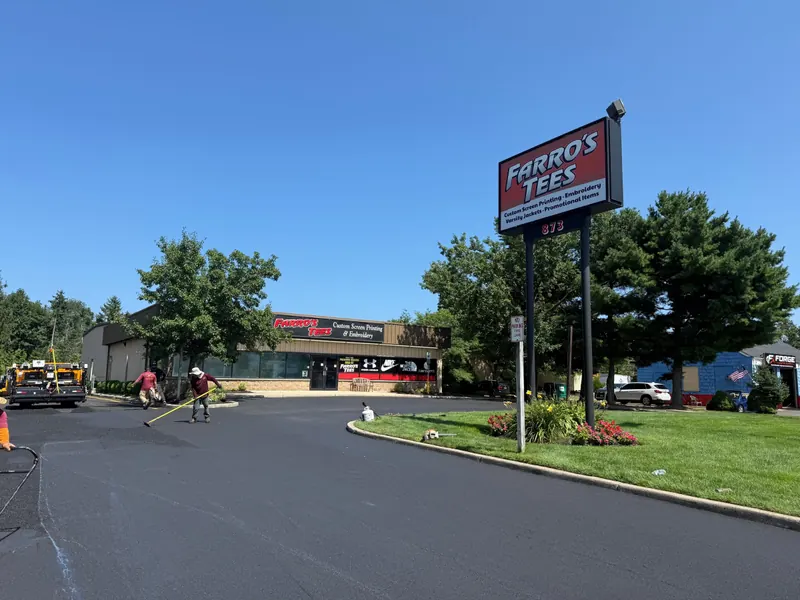
Customer-facing lots need to look good and stay open. We phase work around business hours and entrances, and we focus on the high-wear areas: entrances, drive aisles and spots where water collects.
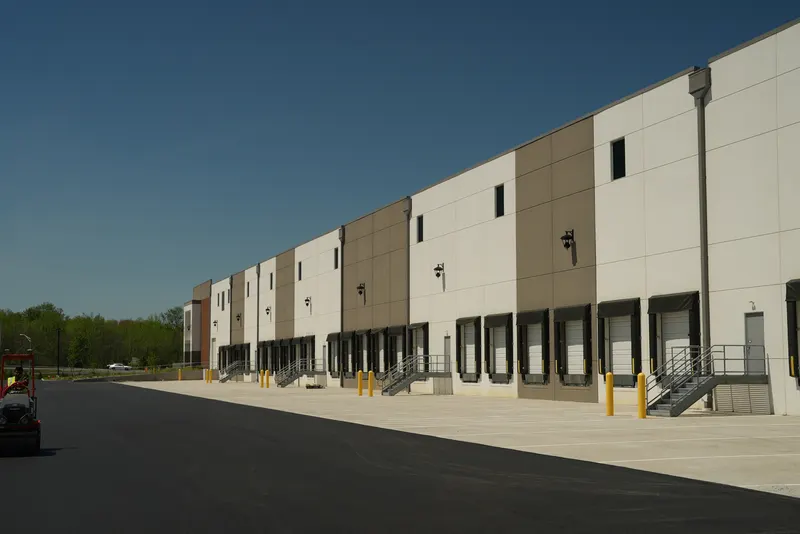
Warehouses and industrial yards
Truck traffic is hard on asphalt, especially where trailers turn, back in or sit on landing gear. These areas typically need a deeper base and more asphalt than the employee parking on the same property, and we size them separately.
HOAs, condominiums and apartment communities
Associations often own their roads, cul-de-sacs and resident parking. Work has to be planned around people who live there, with clear notice, phased closures and access kept open. We can walk the community with a manager or board member and break the proposal into phases that fit a reserve budget.
Private roads and access drives
Long shared drives, private lanes and access roads behind buildings tend to fail at the edges and in low spots. We correct the crown or cross slope so water leaves the surface, rebuild the shoulders and edges, and pave a surface that can carry service vehicles.
Churches, schools and institutional lots
Churches, schools, community buildings and public facilities often have tight windows, such as summer breaks, weekdays between services, or the gap between events. We plan the scope to fit those windows, keep drop-off lanes and accessible parking in mind when we phase the work, and provide the written detail boards and purchasing offices need.
HOA and community lots
Beyond roads, many communities own clubhouse lots, pool parking and visitor spaces. These can often be paved in one or two days if residents get enough notice, and we can schedule them together with community road work so the association handles a single project instead of several.
New roads for builders
If you are building a new neighborhood, the roads, cul-de-sacs and entrance streets are a project of their own, with base course during construction and top course at the end. That work is covered on our subdivision road paving page.
What goes into a commercial job
- Site assessment. We walk the property, mark failed areas, look at drainage paths and inlets, and note traffic flow and truck routes.
- Written scope. The proposal separates milling, full-depth repairs, base work and paving, area by area, with asphalt thickness and the number of lifts.
- Scheduling and phasing. We agree on work windows and how traffic will move during each phase.
- Milling and excavation. Worn surfaces are milled, failed sections dug out, and millings recycled. Details are on our asphalt milling page.
- Base and grading. Aggregate base is placed and compacted, and grades are set to move water to drains and off the pavement.
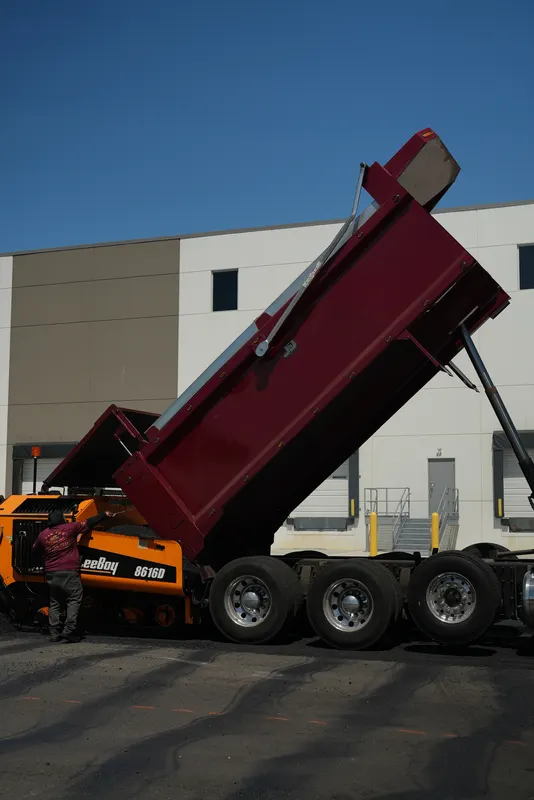
- Paving in lifts. A base course and a surface course are placed with a paving machine and compacted with rollers.
- Closeout. Cleanup, a walkthrough with your representative, and reopening.
Milling and new paving for commercial properties
Most commercial work falls into one of two approaches, and many properties need some of each.
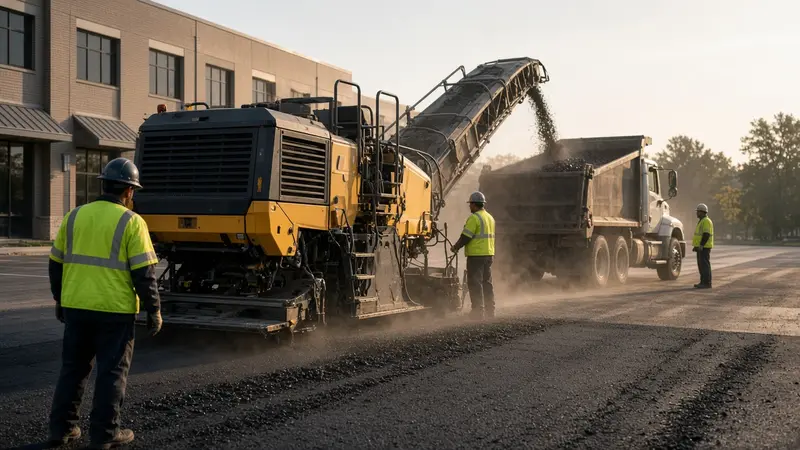
Milling and new paving is for lots where the base is still sound but the surface is worn out. A milling machine grinds off the old asphalt to a set depth, which keeps the finished surface level with curbs, sidewalks, inlets and building entrances. The milled surface is cleaned and tacked, and new asphalt is paved and rolled. The millings are hauled off and recycled.
New paving on a new base is for lots that have failed underneath, for new construction and for expansions. The old pavement and soft material are excavated, a compacted aggregate base is built and graded for drainage, and the asphalt goes down in a base course and a surface course.
Our post on milling vs. full-depth replacement for commercial lots walks through how to tell which one your property needs, and asphalt parking lot paving for NJ businesses covers planning a new lot or a full replacement.
Thickness and structure for commercial loads
Commercial pavement is usually thicker than residential pavement and placed in two lifts. The aggregate base below is thicker as well. How much depends on the traffic: employee parking for cars needs far less structure than a loading area that sees tractor-trailers every day. Instead of one thickness for the whole site, we design areas to what they carry, which puts the money where the loads are.
Keeping a property open while we work
The hardest part of commercial paving is often not the asphalt. It is keeping customers, tenants, residents and deliveries moving while part of the property is closed. Before work starts, we agree on which entrances stay open, where people park in the meantime, when trucks can reach loading areas, and how long each section stays closed after paving. Work zones are closed off with cones and barricades, and the schedule is written down so your team can send notices in advance.
On larger properties this usually means paving in sections over several days. It takes a little more planning, but it means the business or community keeps functioning the whole time.
Scheduling around business hours
Every property has quiet times. For an office it may be a weekend, for a retail center an early morning, for a church a weekday, and for a school the summer break. We ask how your property is used through the week before we propose a schedule, and we build the phases around those quiet windows. Fresh asphalt needs time to cool and set before traffic returns, so the schedule also spells out when each section reopens.
When a smaller scope is enough
Not every commercial property needs a full rebuild. If the base is sound and the trouble is a worn surface, settled inlets or water collecting in a few areas, correcting the drainage and edges and then milling and repaving can renew the property without full reconstruction. When failures spread across the whole site, the base needs to be rebuilt. We will tell you honestly which side of that line you are on.
Factors that shape commercial pricing
- Area and the mix of mill-and-repave versus reconstruction.
- Milling depth and the amount of base repair.
- Traffic loads and the resulting thickness and lifts.
- Drainage corrections and grade changes.
- Phasing, work hours and traffic control.
- Access for trucks and equipment.
For a general look at how asphalt work is priced, see our how paving jobs are priced. Background reading: the benefits of asphalt for commercial paving, what to consider when expanding commercial parking and reasons your business parking lot needs asphalt.
Commercial service area
We take on commercial work in Monmouth County, Ocean County from Toms River north and southern Middlesex County, including Freehold, Middletown, Toms River, Jackson, Monroe and South Brunswick.
Questions about commercial asphalt paving
What kinds of commercial properties do you pave?
We work on retail and office properties, warehouses and industrial yards, condominium and HOA communities, apartment complexes, churches and other institutional buildings, and municipal or public facilities. The common thread is asphalt surfaces that carry vehicles: parking areas, drive lanes, private roads and access drives.
Can you provide a proposal our board or owner can compare?
Yes. After a site walk we provide a written proposal that breaks the work out by area and describes milling depth, base repairs, asphalt thickness and phasing. That makes it easier for a board, owner or purchasing office to compare bids on the same scope rather than on a single number.
Do you pave private roads in HOA communities?
Yes. Many associations own the roads inside the community, and those roads see daily resident traffic plus trash trucks and deliveries. We assess the road sections, rebuild failed areas, mill where the finished height matters at curbs and driveway entrances, and repave in phases so residents can still get in and out.
Can you pave outside our business hours?
We plan the schedule around how your property is used. That can mean starting early, working sections while the business stays open, or saving the busiest entrance for the slowest day of the week. We agree on the work windows before the job is booked, so you can tell tenants, customers or staff exactly what to expect.
Do you mill and repave commercial lots, or only install new ones?
Both. When the base under a lot is still sound, milling off the worn surface and paving new asphalt renews the property without a full rebuild. When the base has failed, or when a lot is being built or expanded, we excavate, build a new base and pave in two lifts. The site walk is where we figure out which approach fits each area of the property.
How do you handle traffic during commercial work?
We plan phases around entrances, deliveries and business hours, and we keep work zones clearly closed off with cones and barricades. Your team gets a schedule showing which areas are closed and when they reopen, so you can notify tenants, residents or the public in advance.